- Blog
- Most Common Questions About Used EVs
Most Common Questions About Used EVs
Get clear answers to the most common questions about used EVs in Europe, from EU rules and VAT to battery checks, warranties, fleet EVs, and where to source used EVs.

EVs are becoming more common across Europe, and there’s also a lot of interest in used EVs.
But since most buyers are accustomed to petrol and diesel cars, they often have questions before they’re ready to commit to EVs.
Whether they ask you about EU rules or battery health, you should be ready.
That’s why we’ll cover the most common questions about used EVs and give clear, practical answers you can use when buying or selling.
Used EV regulations in the EU - FAQ
Let’s start with the legal aspect of owning an EV. In practice, it’s not more complicated just because it’s electric.
► Do dealers need battery certification when selling used EVs in the EU?
There’s no EU rule that forces dealers to provide a battery health certificate (SOH report) when selling a used EV.
However, providing this document could help you describe the car’s value better, because you can point to a measured battery state of health (SOH) figure.
► Is an EV battery passport a requirement in 2026?
Battery passports aren’t yet required in 2026, but they will be soon.
According to the EU Battery Regulation (EU) 2023/1542, EV batteries placed on the EU market must have a battery passport from 18 February 2027.
► What are cross-border VAT rules for used EV sales within the EU?
In terms of VAT, EVs are no different than used petrol or diesel cars.
When you buy and sell any used cars across EU member states, VAT treatment depends on whether you apply the standard VAT scheme or the margin scheme.
► What are the tax benefits for business buyers purchasing used EVs?
Most EV incentives and benefits refer to new EVs only, not used ones.
Still, many countries make ongoing car taxes cheaper for EVs, and these advantages usually apply to used EVs too.
For instance, EVs may pay lower or zero road tax, or a reduced company car tax.
EV battery and technical assessment - FAQ
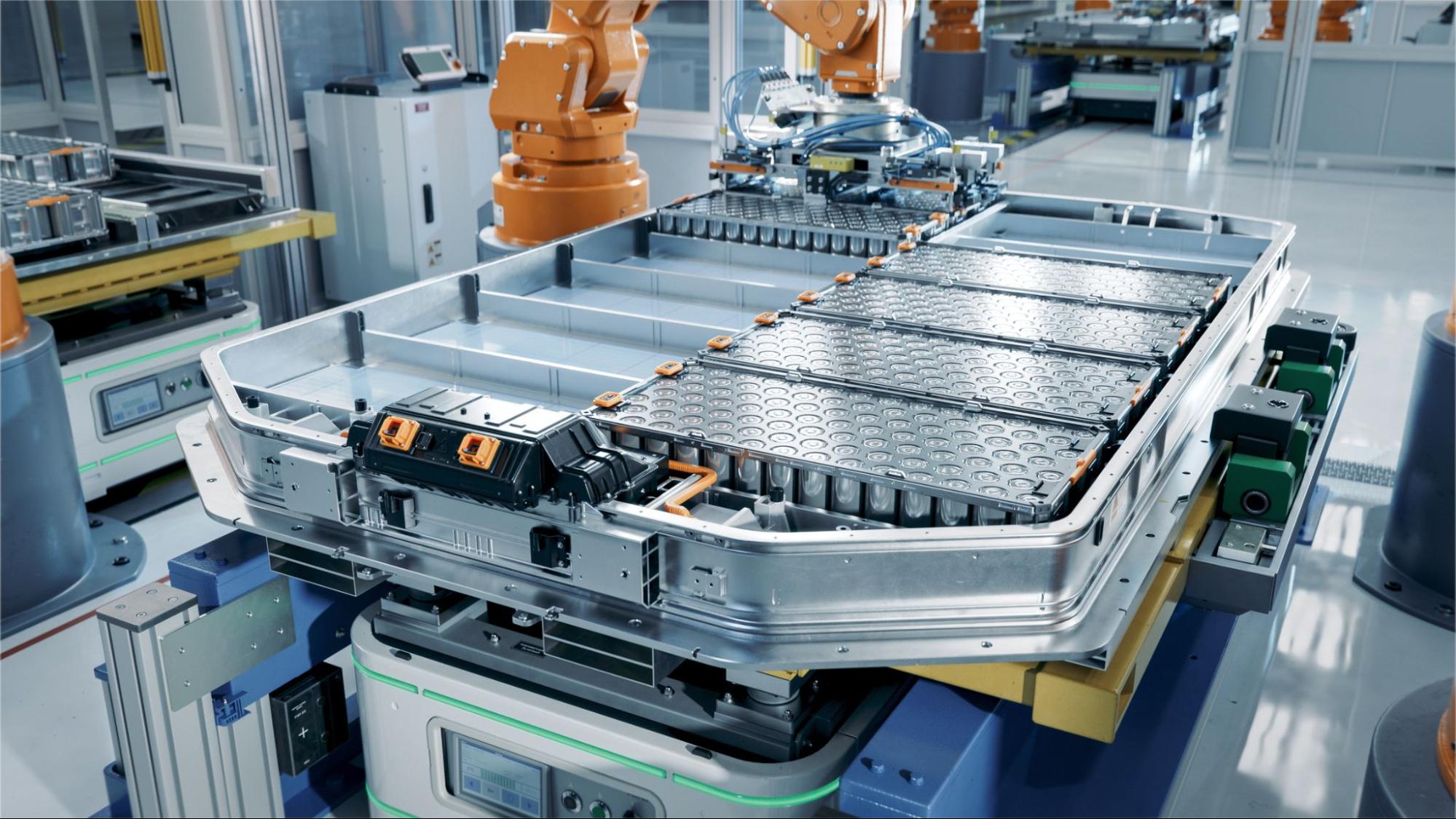
Now, let’s see what there is to know about the most important part of an EV: its battery.
► What are the key inspection points for a pre-owned electric vehicle?
Before a customer buys a used EV, they should check:
- Battery condition: Get a battery state of health report if possible, and check for battery-related warnings/fault codes.
- Charging: test AC charging, and also test DC fast charging if you can.
- Warranty status: Confirm what’s left of the battery warranty.
- Thermal system: Look for issues with battery cooling/heating (there might be problems with charging if the battery can’t stay within its normal temperature range).
► What’s the minimum battery SOH dealers should accept when buying used EVs?
When buying used EVs, you should always expect the battery SOH to be lower than 100% because of regular EV battery degradation.
But, what percentage is acceptable?
There’s no universal minimum SOH, but the general rules are:
- 85%+ SOH: Easiest to resell.
- 75–85% SOH: These EVs can sell well if you adjust the price to make them more attractive.
- Below 70% SOH: Selling these cars only makes sense with cheap pricing or refurbishment options because buyers will be concerned about battery range.
► Which used EV brands have transferable battery warranties?
Most EV brands offer transferable battery warranties, as long as it’s still within the time and mileage limit (for example 8 years / 160,000 km, depending on the model).
Some manufacturers explicitly state that the battery warranty stays valid for used cars, including Tesla, BMW, Kia, and Volkswagen.
Many others have the same option as well, but it’s always good to check warranty terms before purchasing.
► What diagnostic tools do dealers need for used EV inspection?
For most dealers, you mainly need one diagnostic tool that works properly with electric cars.
It should read the battery system and other EV modules, and it should also give you a battery health (SOH) report you can show to buyers.
► Can you jump-start a car with your Tesla or other electric car?
You should never use EVs to jump-start other cars, either EVs or ICE cars.
Tesla’s owner’s manuals explicitly say that Tesla vehicles can’t be used to jump-start another vehicle, as that can cause damage.
Used EV pricing and valuation - FAQ
EV prices can change faster than ICE prices, mainly because the market changes quickly and battery condition has a bigger impact on value. Here’s what to keep in mind.
► Which used EVs have the highest dealer profit margins in 2026?
Dealer profit margins highly depend on where you’re sourcing from and how quickly you can resell the car in your local market.
Still, if you’re looking for best used EVs that usually have strong demand, these are good options: Tesla Model 3, Tesla Model Y, Volkswagen ID.3, and Volkswagen ID.4.
► How much does a used electric car typically depreciate?
Depreciation rates vary a lot by model and market.
In general, EVs typically lose around 20% of their value within the first year, and around 40% after three years.
► Where to find used EV deals?
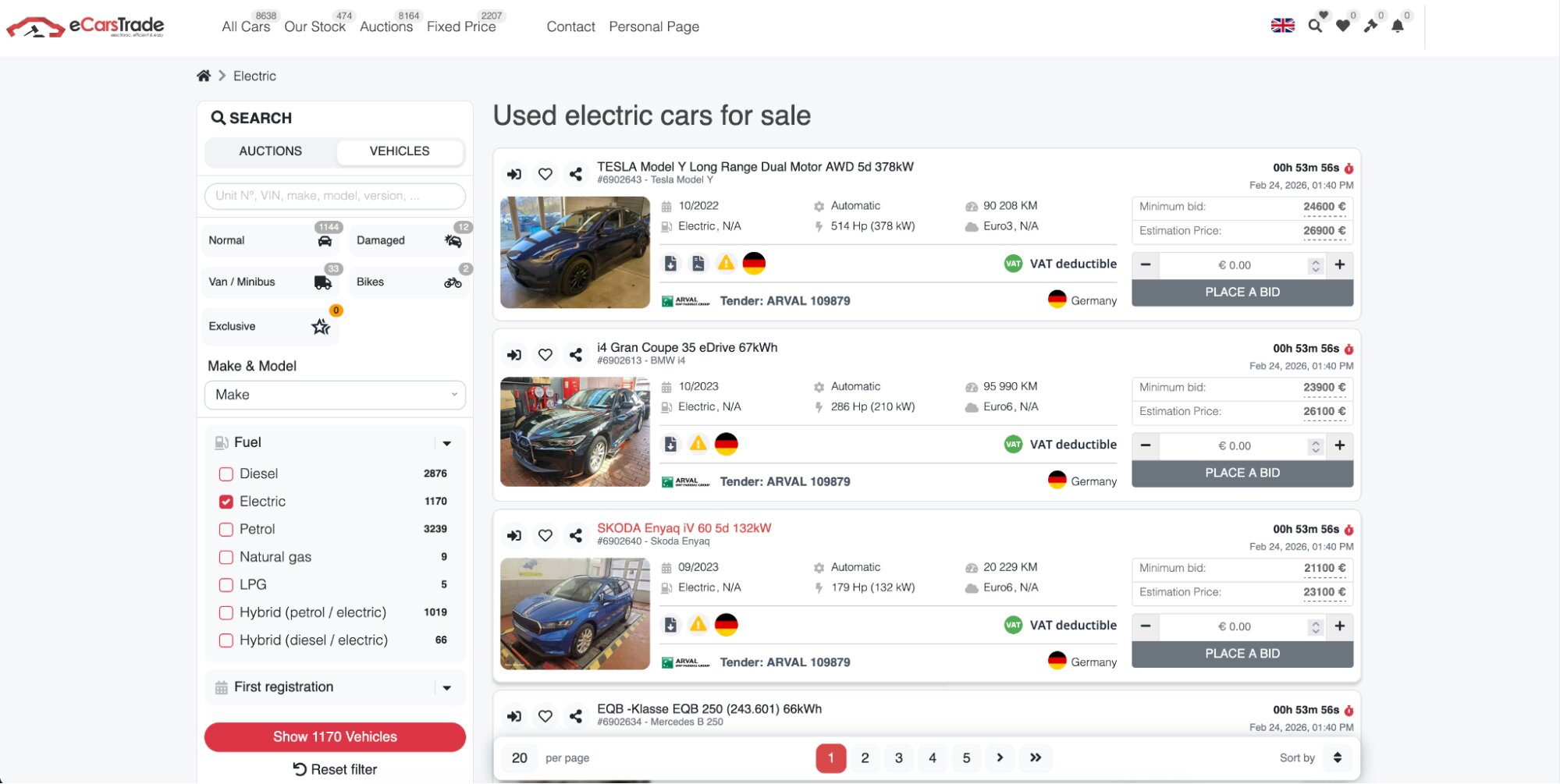
You’ll find used EVs in the same places where you’d find used ICE cars: good options for sourcing are ex-lease and fleet returns and B2B auctions like the ones on eCarsTrade.
► How to value EV trade-ins with degraded batteries?
You should start by finding the market price for the same model with an average battery condition.
Then, measure the battery health and check how much of the warranty is left.
Based on that, adjust your offer to reflect the expected range loss, and keep the adjustment consistent across similar listings so your pricing stays predictable.
Fleet and Commercial Used EVs - FAQ
Ex-fleet vehicles can be a good source of used EVs, whether you’re looking for passenger cars or commercial vans.
These questions and answers will help you figure out whether ex-fleet vehicles make sense for your dealership.
► Should dealers stock ex-fleet electric vehicles?
Yes, ex-fleet EVs can be a good option if you can verify they’re in good condition.
These EVs often come with a clearer history than private cars, but you should still check all the info about their battery condition before purchasing.
► What are the pros and cons of ex-fleet used EVs?
Ex-fleet used EVs are often easier to assess because they usually have a clearer service history and usage information.
The downside is that they can come with higher mileage and heavier use, so battery health and real-world range can vary.
► Are commercial electric vans profitable for dealers?
They can be, especially where businesses want lower running costs and access to low-emission zones.
However, profitability mostly depends on your local demand, typical routes, and how easy it is for buyers to charge.
EV sourcing - FAQ
So, where and how can you find reliable used EVs? Let’s find out.
► Where do dealers source pre-owned EVs for stock in Europe?
If you’d like to save time and avoid buying from private sellers, B2B platforms like eCarsTrade are one of the simplest ways to source pre-owned EV stock in Europe.
With eCarsTrade, you buy online through auctions and listings built for professional traders, so you can browse many EVs in one place and keep your sourcing process efficient.
► Can you buy used EVs on eCarsTrade from any country in Europe?
Registered car traders from any country in Europe can buy EVs from eCarsTrade.
However, the cars on eCarsTrade don’t come from every European country; they’re mostly sourced from markets like Belgium, France, Italy, Germany, Luxembourg, and the Netherlands.
► What to check in auction reports before bidding on used EVs?
You should start by checking potential risks specific to EVs, like any battery or charging warnings or faults, evidence of charging issues, and any battery health info mentioned.
Then, confirm the basic elements you’d check for any car: the VAT scheme, mileage, and damage photos.
Used EV market in the EU - FAQ
Used EV demand is growing, but what sells fastest still depends on your local market, charging habits, and what buyers already know and trust.
These answers help you pick EVs that fit your dealership the most.
► Best second-hand EVs to stock in 2026?
A good strategy is to focus on models that customers are already familiar with, like Tesla Model 3, Model Y, Audi e-Tron, or VW ID.4.
Of course, some markets prefer emerging Chinese EV brands, so it’s worth checking local demand before stocking up on specific models.
► What are the used EVs with the fastest charging capabilities?
If you’re looking for models that can often charge from 10% to 80% in under 20 minutes on a high-power DC charger, good examples are the Hyundai IONIQ 5, Kia EV6, and Porsche Taycan.
► What are the best value second-hand electric cars for families?
Good used EVs for families include Skoda Enyak, Kia Niro EV, MG4, Hyundai Kona Electric, and Kia EV6.
► Which used EV segment has the fastest turnover: compact, SUV, or premium?
This varies by country, but in many markets, compact EVs and popular SUVs tend to sell faster than premium models because they fit more budgets.
► Are Chinese EV brands (BYD, MG) resellable in the EU?
Yes, Chinese EVs get resold in the EU, and they’re becoming more common.
Before stocking them, check what service and parts support exists locally, so you can clearly tell buyers where they can maintain the car.
_01JE9WH8CRTMG3B3WDH56WNJHD.png)